Scotland was very keen on castles. The proliferation of them in every corner of the kingdom, and in building them longer than other parts of Europe is sometimes taken as evidence for Scotland’s violence and backwardness. Happily, that wasn’t really the case, Scotland wasn’t any more violent than anywhere else, it just had a culture of castle building. The eighteenth century was a disaster for Scottish heritage, so by the time Walter Scott and revivalism came around in the nineteenth, the old ruins had long been stripped of a lot of their grandeur, so presented a much bleaker view of the past. When you can’t see the painted ceilings, the fine tapestries, roaring fires or delicate woodwork, all you are left with are gunloops and battlements.
Thick walls and small windows were good adaptions against the wind and rain, while the trappings of castle-ness suited lairdly and lordly vanity. Charles McKean made the very convincing argument that most Scottish castles of the early modern period should rightly be seen as akin to French Chateau.
It was said of the Earls Marischal that they could travel from Berwick upon Tweed to Caithness and eat and sleep every night on their own estates. While this was an exaggeration, if they travelled along the east coast and had good weather for sailing, then it may actually have been possible.
The earls held many castles directly for their own needs, then others they kept but let supporters occupy. Then the Keith cadet branches held a bundle more in their own right. Looking at this great collection as a whole gives us a better understanding of what they were each for and how they fitted within the earldom.
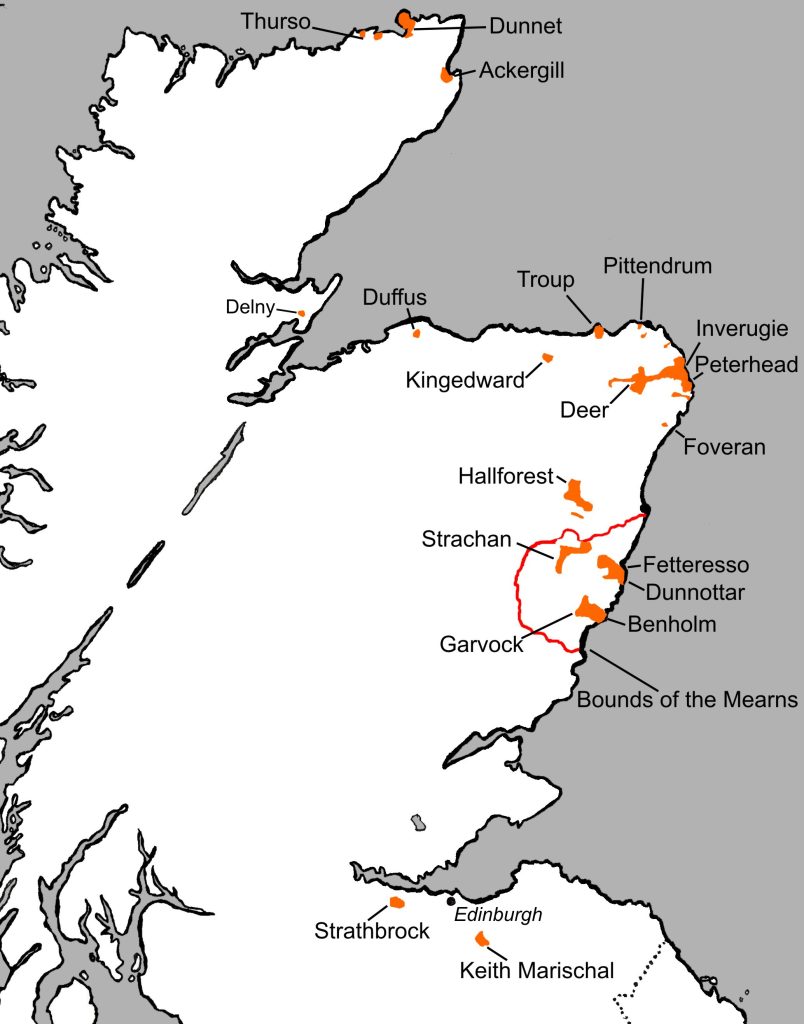
Dunnottar Castle, the chief house, is rightly celebrated as one of Scotland’s most iconic castles – which was the point. It’s meant to look amazing. But setting it within the earldom we learn that it was a dual house with nearby Fetteresso. Dunnottar was a palace for entertaining and showing off, and a national fortress, but Fetteresso was a villa on a grand scale with very extensive terraced gardens. Up in Buchan, the leading seat there was Inverugie, but within eyesight was the formidable Ravenscraig, and the ancient motte, revealing three ‘castles’ is short walking distance from each other, making up a single noble landscape. The notes on the various houses below hope to explore these themes further.
Not a single castle from the sixteenth or early seventeenth century survives today intact, or at least recognisable. Fetteresso and Ackergill in Caithness at least have roofs, but have been thoroughly transformed. So a substantial Scottish architectural and artistic legacy is now completely lost.
Marischal’s Castles
Pages under construction.
Keith Marischal
Ancestral home of the Keiths and an overlooked major Renaissance palace.
Dunnottar
The chief house of the Earls, a magnificent cliff-top fortress.

Fetteresso
Sister house to Dunnottar, the earls’ pleasure villa with extensive parkland.
Aberdeen
The Earl’s Marischal’s Town House on Castle Gate
Benholm’s Lodging.