The ‘Black Stock’ was a solid oak table housed in a special room at Dunnottar Castle. ‘Stock’ is related to the word ‘stump’ and essentially refers to the trunk of a tree. On this great supplies of meat, bread and other foods were kept and to which all needy folk or travellers were admitted to and fed for free. This was a sign of the hospitality of the Keith Earls Marischal, who owned the castle.
The first reference to the Black Stock was in 1617. John Crowe an Englishman attending King James VI and I’s visit to Scotland described how a group of the English party had visited Aberdeen and on their way visited Dunnottar Castle. While being dined by George Keith the 5th Earl Marischal, they asked him ‘bot wher is the blak stok that we have heard tell of in England?’ Marischal took them to it:
‘This blak stok is of ane ould oak of a grit thiknes, standing on stompes in a hous be itselff. The use of the blak stok has bein thus. Quhatsumever they wer traveiling by the way, many or few, being needfull of meit and drink, wer let into the castle and sate doun at that blak stok, and had meit and drink in abundance and never payed anything for it’.[1]
This source is quite remarkable, not only showing that the stock was considered old at this time, but stories of it had reached far south into England. With later accounts we get the picture of a rough horizontally laid stump, either a very large plank of maybe even trunk half, through which four round stumps passed to make the legs.
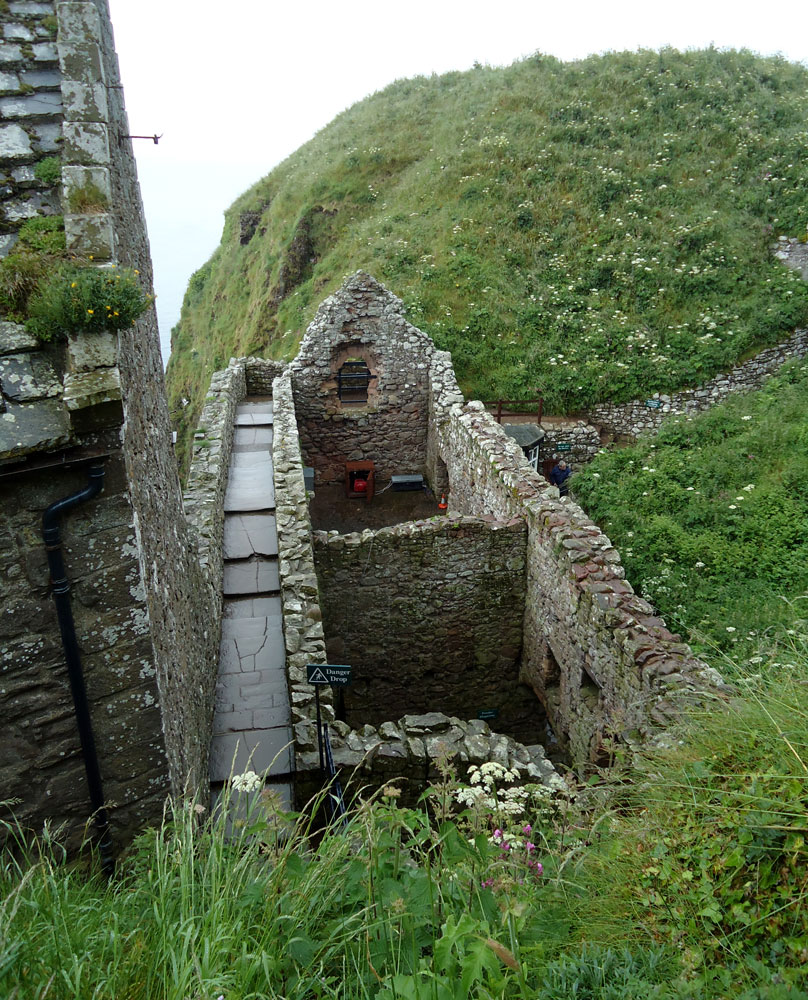
The stock was presumably kept near the entrance of the castle, presumably in one of the ‘gatehouse’ rooms.
Writing in the 1640s, John Keith the minister of the parish described ‘the black stock a monument of Hospitality and open House holding there. It was still covered with all sorts of Vivers of meat and drink, and all men that came to the place, accepted to it.’[2] In these early mentions the significance of the stock seems to be in how it represented such unrestricted largess. Overtime the stock itself seems to have taken on its own mystique. After the famous siege of Dunnottar during the Civil Wars, the castle’s contents were confiscated by Parliamentary forces. On 29 March 1652, George Ogilvy of Barras wrote to the Countess of Marischal saying of the sixth Earl Marischal that ‘My Lord desyrs to be carefull of the black stock and provyd the samen’.[3] Clearly of all the treasures of the castle, this old trunk was of particular concern for the earl.
In 1844 (following Douglas’ Peerage of the 1790s), the Black Stock was described as ‘an oaken table said to be bought by the Catti from Germany, reckoned an ancient heir-loom of the family, purchased by Alexander Keith of Ravelstone off of the last Earl Marischal’.[4] Alexander Keith 1736–1819 built Ravelstone House, Dykes Road Edinburgh, in 1790, which is where the Stock was kept until at least 1925. In 1896 it was remarked that the table in Ravelstone House ‘had been made from planks taken from the ships which had bought the Chatti from Germany’. [5] The Keiths are almost certainly not descended from the ancient Chatti (described by Tacitus), that was a well-intentioned, but ultimately wishful story bolted onto the family pedigree by the 5th earl. But whatever origins the actual stock had, it had clearly attracted speculation over the centuries.
We have a good description of the stock in its final configuration. At some point between 1617 and 1925, probably by Keith of Ravelstone around 1800, it lost its rough stump legs and was turned into a more conventional table. It apparently took the form of a single slab of oak, 9cm thick and 113 cm by 44.5 cm, enclosed by a mitred border of 14cm wide. There was a silver plaque affixed to it bearing the inscription:
‘Post varios casus, per multa discrimina rerum In Germania, regnant Othone, orta: Ad Cathnesiam devecta, In Londoniam deportata, Dunnotyrae, quingentos per annos Hospitii muneribus functa In rebus adversis ad Kethi aulam deducta Denique a Georgio Comite Marischallo Amico et patrueli suo Alexandro Ketho de Ravelston donate Strips ista gentis Chattorum Jam millenaria Hic tandem requiescit’.[6]
This translates roughly as:
After various fortunes, through many perils of events, In Germany, when Otto was reigning, it arose; Carried to Caithness, Transported to London, At Dunnottar, for five hundred years, It fulfilled the duties of hospitality; In adverse times it was brought to Keith Hall, Finally bestowed by George, Earl Marischal, A friend and kinsman, upon his cousin Alexander Keith of Ravelston. This relic of the race of the Chatti, Now a thousand years old, At last rests here.
The last mention is in 1925 in Douglas Barron’s book on Dunnottar Castle, when it was owned by Sir William Keith-Murray. What happened to it and where it is now is unknown. An appeal for information was run in the Glasgow Herald – unfortunately there has been no response. If you have any leads I would be keen to hear from you!
[1] Historical Manuscripts Commission. Fourteenth Report, Appendix, Part IV. The Manuscripts of Lord Kenyon (London, HM Stationary Office, 1894) p.21
[2] Mitchell, A. & Clark, J. eds, Geographical Collections relating to Scotland Vol.3 (Edinburgh, Scottish History Society, 1908) p.238
[3] Howden, C. ed., ‘Papers Relative to the Preservation of the Honours of Scotland in Dunnottar Castle 1651-1652’ in Wariston’s Diary and Other Papers (Edinburgh, Scottish History Society, 1896)p.119
[4] Keith, R., History of the Affairs of Church and State in Scotland (Edinburgh, Spottiswood, 1844) p.lxxiv
[5] Howden, C. ed., ‘Papers Relative to the Preservation of the Honours of Scotland in Dunnottar Castle 1651-1652’ in Wariston’s Diary and Other Papers (Edinburgh, Scottish History Society, 1896)p.119
[6] Douglas Gordon Barron, The Castle of Dunnottar and its History(Edinburgh, 1925)