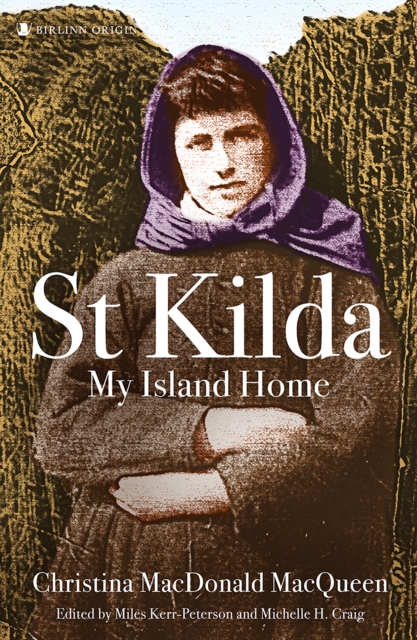
The following article was written to publicise St Kilda, my Island Home: Christina MacDonald MacQueen,co-edited with Michelle Craig and published by Birlinn.
Throughout its history, Glasgow has long welcomed waves of incomers, from Scotland, Ireland, Europe and the wider world. While it has been a haven and refuge for some, it has proved a prison for others. Those from the Highlands and Islands fall into both categories – some forced from their homes through clearance and economic hardship, others left their communities for the bright city lights, often finding disillusionment.
When the final inhabitants of Hirta departed in 1930, it brought to a close thousands of years of unbroken settlement on the St Kilda archipelago. For generations, this isolated group of islands in the North Atlantic supported a resilient community, cut off from the Scottish mainland for much of the year. Their survival depended on bird hunting, sheep farming, and weaving tweed—a way of life deeply shaped by the surrounding sea and seabirds.
Despite enduring harsh conditions—absentee landlords, recurring epidemics, and heartbreakingly high infant mortality—the islanders endured. But after the First World War, the pull of modern life grew stronger. Young people began to leave in search of better prospects, primarily to Glasgow, and the population steadily declined—from 80 in 1911 to just 36 by 1930. Those who remained were too elderly or too young to sustain the community. Confronted with an unsustainable future, the residents turned to the government for assistance, leading to their evacuation to the mainland.
The story of St Kilda has seared itself into Scotland’s collective memory—a haunting symbol of abandonment, the erosion of ancestral ways, and the aching cost of modern progress. It has stirred a flood of books, songs, and poems, each echoing with longing and loss. Yet amid this chorus of remembrance, one voice has remained in the shadows—Christina MacDonald MacQueen, whose story has gone largely untold.
Christina MacDonald MacQueen was born and raised on isle of Hirta, but in 1909, but as a young woman she was hungry for more than the rhythm of tides and tradition. And so she left. Drawn by the allure of Glasgow’s gaslights and opportunity, she exchanged her father’s hand-woven tweed for modern city fashions. In the genteel streets of Hyndland, she worked as a domestic servant and later married a Lowlander, Robert Chalmers. Together they built a home and raised a family—but the sheen of the mainland dulled with time. Longing crept in. For Christina, the steep sea cliffs, wheeling seabirds, and Gaelic songs of St Kilda never loosened their grip on her heart.
In late 1929, as a quiet anxiety stirred over the fate of the dwindling island population, Christina began to write newspaper columns that painted vivid portraits of her childhood among a vanishing way of life. At that point, talk of evacuation remained vague, more murmured concern than concrete plan.
Then tragedy struck. In February 1930, Christina’s sister, Mary Gillies, pregnant and in distress, was evacuated to Glasgow after urgent appeals from the island’s nurse, Williamina Barclay. On 26 May, Mary and her newborn daughter, Annie, both died. Earlier that same month, galvanized by Mary’s crisis, the islanders—guided by Nurse Barclay—had penned a plea to the Secretary of State for Scotland, requesting resettlement on the mainland.
Christina, shattered by family loss and fearing the end of her homeland, kept writing. Her tone shifted. What began as nostalgic reflection became a fierce cry of protest. She condemned the neglect of successive governments and mourned the decision to abandon the island. Though the remaining St Kildans had formally asked to leave, Christina refused to see their letter as consent—it was, in her eyes, a cry born of desperation.
She and her brother Donald, then working in Glasgow’s shipyards, begged to join the evacuation ship. They were denied. Christina’s response to the authorities burns with sorrow and fury:
“I am anxious to tell my people something about Mainland life that has not been told them, and further, to appeal to them to make Governments, of whatever colour, do their duty and save the home that was mine and my father’s, rather than destroy it. The whole business from start to finish has been the work of despairing Sassenachs.”
After the island’s final evacuation, Christina published two last articles—one chronicling the perilous tradition of seabird hunting, where men dangled from sheer cliffs on ropes; the other a tender tribute to Rachel MacCrimmon, an elder whose soot-darkened blackhouse had once pulsed with story and song. In that final piece, Christina returns in memory to her girlhood, spinning wool beside Rachel, lost in the warmth and wisdom of the old ways.
She had intended to write her own book about St Kilda, but it was never finished. Perhaps life intervened—or perhaps the pain of remembering proved too heavy to carry alone. Now at least, her scattered writings have finally been gathered and published in a single volume by Birlinn.
Christina’s voice matters—profoundly. First, because she was there: a native St Kildan offering a rare, intimate account of the island’s last chapter, unlike the many outsider perspectives that dominate the record. Second, her recollections are a rich seam of social history, particularly of women’s labour—milking cows, waulking tweed, plucking seabirds. And finally, she was the only St Kildan woman known to have written so extensively about her homeland. In doing so, she gave voice to a silenced world—and ensured it would not be forgotten.
It is astonishing, given the breadth of literature on St Kilda, that Christina’s voice has been so neglected. Among her family’s papers was a note she wrote in red ink, a quiet manifesto of longing and purpose:
“I have written these articles about far off lonely Hirta: far away and lonely myself, a stranger in the lowlands, longing always, and dreaming of days and folk that are no more.
I have written to care my heart and that my children may know and know of the kindly race and distant isle from where their mother came. Never before has a daughter of Hirta written of the island home in an alien tongue. I am in hope that besides my children others may read of these fond memories, of a lonely isle and my people who lived so happy.”
Christina MacDonald MacQueen’s journey is uniquely her own—yet it echoes the path of so many others: islanders, Highlanders, crofters, and rural children who traded the familiar rhythms of home for the city’s promise, only to find themselves stranded between two lives, belonging fully to neither.