As well as Kirk Patronage, I’ve also looked at church buildings in Scotland in the immediate post-Reformation period. See:
- 2016 ‘The Church Architecture of the Keith Earls Marischal 1560 to 1623’ in J. Geddes (ed.) Medieval Art, Architecture and Archaeology in the Dioceses of Aberdeen and Moray, Routledge, pp. 99-120.
- 2014 ‘Neo-Latin on Tombs: the Case of Benholm’ feature for Bridging the Continental Divide
Burntisland rightly gets much attention as a radical experiment in new architecture, but most parishes through out Scotland had to try their best to adapt narrow long buildings focused on the sacred mass to preaching boxes. Between the three major milestones of the Reformation in 1560, ‘Presbyterian’ Burntisland in 1592 and the ‘Episcopalian’ Dairise of 1620 there’s an interesting story of everyday cobbling together and making the best with what’s available. And there’s also the story of noble interference. The kirks within the earldom of the Keiths presents this story quite well. That said, any study of this sort is hampered by the utter devastation wrought on Scottish churches through the 18th century, where vast numbers were either abandoned or flattened, or even dynamited (Benholm).
The essential story from the Reformation is that the church was on unstable financial footing, so efforts had to be made that buildings were serviceable with the essentials – roofs and windows being a surprising thing to even have to mention in the kirk’s Book of Discipline. Some superfluous chapels where there was already a parish church might be abandoned (such as Cowie in Fetteresso parish and Auchreddie in Deer parish for example). Fetteresso old kirk is a good example of an ill-suited building adapted as best as possible – the long building ultimately being shorted and an aisle added to the side.
Meanwhile noblemen were keen to continue traditions of burial within churches, despite the General Assembly being utterly opposed to such practices, and so a fudge of burial aisles came about – where old kirks would have a new extension on the side, to create a T-shape. Within this aisle the nobles would bury their dead, erect elaborate memorials, and have a loft facing into the body of the church, often directly opposite the minister’s pulpit. Dunnottar, Benholm, Old Deer being examples of these.
By the 1610s the Kirk was in a more stable footing, so was able to conduct reforms, rationalising the old medieval parish patchwork and even building new churches. Some more churches were abandoned in this phases (Fetterangus and Keith Marischal), some moved to locations better suited to the parishoners (Longley) and wholly new churches built in wholly new parishes (New Deer and Longside).
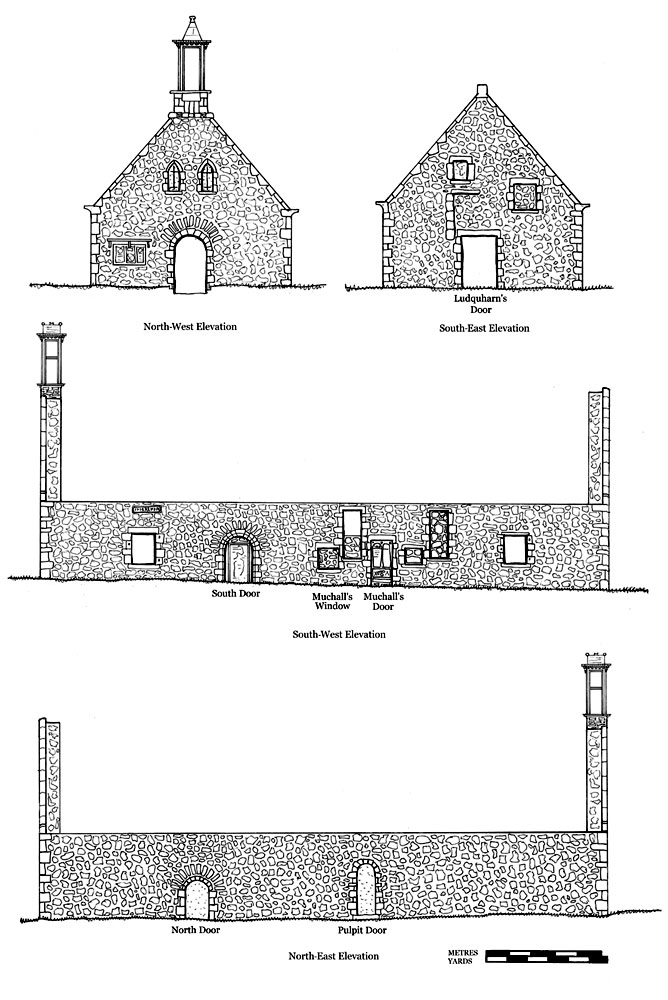
A violent feud between the Keiths of Ludquharn and the Frasers of Muchall erupted in 1620 during the building of Longside kirk. This was essentially a petty disagreement over where each of them would sit, but the subsequent violence led to an extensive paper trail, which gives fascinating insight into the making of this new church. What may seem mad to us, is that the shell of the building was made first, and then the space inside was divided for seating, which led to new doors and windows being punched through the walls. Hence the accumulation of blocked in features on the building we might usually assume to have been the result of decades of use, mostly date to the church’s construction. Unlike Burntisland or Dairise, Longside is a surprisingly traditional church-style building – not as narrow as old Fetteresso – but at the same time representing a pre-Reformation mindset in what churches should look like.