I’ve had many trips to consult the Aberdeen Town Council Registers, which are a very rich source on life in the burgh. They’re a combination of council decisions a register of legal settlements and transactions. The below example explores the Earl Marischal’s town house in the Castle Gate. Although I live in the central belt, I am happy to conduct research in Aberdeen for you, so please send a message for a quote.
The Earl Marischal’s Town House in Aberdeen
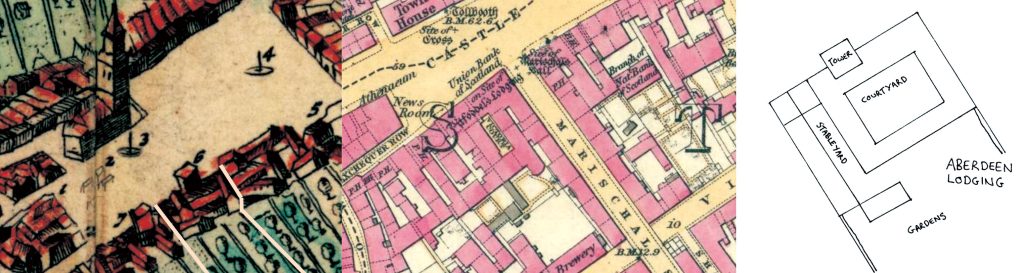
In Aberdeen Marischal owned a large town house opposite the Tollbooth which backed onto the quay. The property fell to ruin after the family’s forfeiture in 1715 and what remained was demolished in 1767 to make way for Marischal Street.[1]
Contrary to the local legend that the house was built in 1540 and accommodated Mary Queen of Scots in 1562, the house was actually built in 1586, as the below transcription shows, which essentially giving George Keith, fifth Earl Marischal planning permission.[2]
Prior to that there is mention that Margaret Home, Countess Marischal, lodged in a Mr. Chalmer’s house in December 1582, so we might assume that Marischal did not have their own house in the burgh at this point.[3]
Marischal’s house in Aberdeen can be seen as a means of promoting Keith influence in the burgh, which had previously been dominated by the Gordon Earls of Huntley. The location of the house underlines this political assertion, being opposite of the Tolbooth, the centre of the civic power in the burgh, and next door to the house belonging to the Menzies, who in 1582 had allied themselves with Huntley and had dominated the council during the preceding century.[4]
The finished house itself is first mentioned the day the Earl formally founded Marischal College. Between eleven and twelve o’clock in the morning on the 21st of April 1593 Marischal visited the sites of the Black and White Friars to formally receive the various lands that would be put towards his Marischal college project. Then, just after twelve, Marischal returned to his ‘house on the south side of the Castlegate’ to complete the legal proceedings and sign the various pieces of documentation.[5] The next mention comes in 1594, when the rebelling Catholic Earls, led by Marischal’s great rival, George Gordon, Earl of Huntly, are recorded as breaking in and staying there.[6]
A dispute arose between Marischal and his next door neighbour, Gilbert Menzies in 1595. Marischal complained of Menzies’ ruinous wall which was a danger to his property; Menzies retorted that the condition of the wall was the result of Marischal having had a gutter directed into his grounds.[7] In later decades we learn of a forestairs in the courtyard.[8]
The only image of the Aberdeen lodging in existence is in Gordon’s map of 1661. This shows an inner and outer courtyard, along with a tower. A tower intended to rival that of the Tolbooth, asserting the earls as a major power in the burgh.

TRANSCRIPTION AND TRANSLATION
Aberdeen Town Council Registers Vol.31 1582-1585
p.736 20 February 1585/6
[Margin on p.737] Previlege anent my lord erll Merschaellis hous in the castell gaitt
The said daye anent the ressonable request and desere of ane nobill and potent lord George erll Merschall lord Keyth, exhibit to the provest bailyeis and counsall in wret, makand mentioun that quhair he hes cost frome Thomas Nicolsone and Mr Thomas Mollysoun twa foirlandis[9] with the pertinentis lyand within the said burt on the sout syd of the castell gait betwyt the land of David Law on the eist part and the land of Alexander Lawsoun on the west part, with the previlegis and pertinents pertining therto
Of the quhilk twa landis, the ane is biggit and the uyer utterlie waist and desert, and that the said Mr Thomas Mollysone being heretabill posessor of the saidis twa foir landis for the tyme obtinit ane licence & libertie of our soverane lord the Kings majestie to him his airis and assignis heretabill possessor of the said foir lands, present and to cum, to big and erect stairis and turncaiessis upoune the north syd wallis of the saidis twa foirlandis for the eaisment of him and his successoris and decoratioun of this burt.
In respect that the same may be lasumlie done becaus of the brandnes and largnes of the gait, without prejudice or hurt of animal or person, and yat he [the earl] is becum in the said Mr Thomas place and now is heretabill possessor of the saids twa landis halding the said Mr Thomas tytill and previlege forsaid, and that he presentlie intendis to begin to build and big the saids twa foirland not onlie for his awin particular conmoditie bot also for decoratioun of this guid toun did thairfoir desyring the saids provest bailyeis and counsaill for thair assistance and consent to big and build the saidis foirlands with sic aismentis and previlegis upoun the north syd wallis therof as in grantit befoir to the said Mr Thomas of the said licence at aucht fute of mesonerie
p.737
direct northe frome the nort wallis of the saidis landis for passage to and fra the same direct northt, furt to the said comond gait, conforme to the said licence of the qhilk the tennor followis:
James be the grace of God king of Scottis To the provest bailyeis counsall and comunitie of our burt off Aberdene and uyer jugis and subjectis quhome it effers greting. Forsameikill as upoun sundre guid ressonable and wechtie consideratiouns welbeing us and our maist nobill antecossor be vertew of sundrie of our lawis and constitutionis maid publeist and promotgat alsweill be thame as us for the commoun weill of the burrowis therof have sett furt diverss actis of parliament for policie to be haid and inttenit within our saidis burrows speciallie in reedeseing of the enyuons places therof demolishit and cassin doun ather be forrein invasioun or negligence of the awneris in suffecing of thair tennentis for laik of beitting to fall down or be suffored uyer wayes to perische, and considering our said burt of aberdene to be ane of the cheifest within our realme and yit not so perfytlie repairit in all tymis as be the tirtiun spectioun and travel of diligent and verteus induellaris in myt be cheiflie in the castelget of the same and handing guid oppinioun of the vertew and ford wardnes of our belovits maister Thomas Mollysoun clark deput of or said burt and David Low burges therof quha hes twa ruynous tenementis and foirlandis lyand contigue togidder on the sout syd of the said castelget for re-edifing therof to the decoratioun & policie of our said burt the said gait being the maist spacious and byand streit of the same therof being uyr within or realme and in respect therof beitting & reparing of the saids twa tenementis to be the mair neidfull and to require the gryttar extensioun of thair turnegressis stairis and wallis thairfoir we have givin and grantit and be the tennor herof of our kinglie powar and our regall giffis and grantis full abertie facultiet licence and tollerance to the said Mr Thomas and David thair airis and assignais present and to cum as heretabill possessors of the saidis twa tenementis and foirlandis lyand betwixt the land off Alexander Lowsoun on the west the land and tenement of David Nicolsoun the eist the said hie streit on the nort and the inlands of Thomas Nicolsoun on the sout to big and erect stairis or turnegressis upoun thais saidis foirlandis on the nort syd wallis of the same as thai sall think maist expedient for the decoratioun of our said burt and thair utilitie for commond passage to be haid to and fra the same direct nort furt to or said commond gait of the breid of aucht fute of mesour and that at the syt and opinioun of yow the saidis provest bulyeis and counsall of our said burt Willand and comandand yow and ilk ane of yow our uyeris legis and subiectis forsaidis and uyeris
p.738
officiaris and juges spirituall or temporall within or realme quhatsummevir That nane of yow presume nor tak upoun hand directlie or indirectlie to mak ony stop impediment or distribulance to the said Mr Thomas and David or thair forisaids in thair extending reedefeaing or bigging of the saidis tenements foirlands the stairs or turnegreissis thairof in maner foirsaid bot rather satisfie concur and assist with thame thairuntill as thee and ilk ane of yow will answer to us thairupone at the uttermost chairg and perell and under all hiest pane cryme and offence that the and ilk ane of yow may commit or intend agains our majestie in that behalf be thir presents giffin under or signet at halirudhous the third day of Apryll and of or regne the auchtein yeir the yeir of god jm vc foirscoir and fyve yeris sic subscribitur, James rex, Huntlie, Blantyre.
Quhilk provest balyeis and counsaill being conveint for the maist part having read understandit and considderit the said licence and preivlege grantit in maner above wrettin and the said erll ressonable request and desyre conforme therto gaif and grantit thair consent to the same providing that the said erll nor his successoris big na farrar furthe nay of stane nor tree but aucht futtis distant from the said nort syd wallis conforme to the said licence and previlege quharupone Mr William Davidsone procurator for the said nobill and potent lord askit note and instenment tharof.
TRANSLATION
On the said day, concerning the reasonable request and desire of a noble and powerful lord, George, Earl Marischal, Lord Keith, presented in writing to the provost, bailies and council, he stated that he had purchased from Thomas Nicolson and Mr Thomas Mollison two forelands with their appurtenances, lying within the said burgh on the south side of Castle Gate, between the land of David Law on the east and the land of Alexander Lawson on the west, together with the privileges and appurtenances belonging to them.
Of these two pieces of land, one is built upon and the other is entirely waste and undeveloped. The said Mr Thomas Mollison, being the hereditary possessor of the two forelands at that time, had obtained a licence and permission from our sovereign lord the King, for himself, his heirs and assigns, as hereditary possessors of the said forelands, both present and future, to build and erect stairs and turning accesses upon the north-side walls of the said two forelands, for the convenience of himself and his successors and for the improvement and decoration of the burgh.
Since this could lawfully be done because of the width and breadth of the street, without inconvenience or harm to any animal or person, and since the Earl had succeeded to Mr Thomas’s position and was now the hereditary possessor of the said two lands, holding the said Mr Thomas’ title and privilege, he now intended to begin building and developing the two forelands, not only for his own particular benefit but also for the improvement and decoration of this good town.
He therefore requested that the provost, bailies and council give their assistance and consent to his building and developing the said forelands, with such accesses and privileges upon their north-side walls as had previously been granted to Mr Thomas under the said licence, namely to a distance of eight feet of masonry, straight north from the north walls of the said lands, for passage to and from them, extending directly northwards to the said common street, in accordance with the said licence, the terms of which are as follows:
James, by the grace of God King of Scots, to the provost, bailies, council and community of our burgh of Aberdeen, and to all other judges and subjects to whom these matters concern, greeting.
Since, upon various good, reasonable and weighty considerations, which have been for the benefit of us and our most noble predecessors, and by virtue of various laws and constitutions made, published and promulgated both by them and by us for the common good of the burghs thereof, we have enacted various Acts of Parliament concerning the policy and upkeep to be maintained within our said burghs, particularly for rebuilding those places within them which have been demolished and cast down either by foreign invasion or through the negligence of their owners, who have allowed their tenants, through lack of repair, to fall down or otherwise to perish; and considering our said burgh of Aberdeen to be one of the chief burghs within our realm, and yet not at all times so perfectly repaired as it might be through the care, inspection and efforts of diligent and virtuous inhabitants, particularly in its Castle Gate; and having a good opinion of the virtue and enterprise of our beloved Master Thomas Mollison, clerk-deputy of our said burgh, and David Low, burgess thereof, who have two ruined tenements and forelands lying together on the south side of the said Castle Gate, for the rebuilding of which, to the decoration and improvement of our said burgh, the said street being the broadest and finest street thereof, and one of the finest within our realm, it is fitting that the said two tenements should be repaired and rebuilt, and that this should require a greater extension of their turning accesses, stairs and walls; therefore, by the authority of our royal power and by our royal gift, we have given and granted, and by these presents give and grant, full liberty, power, licence and permission to the said Mr Thomas and David, their heirs and assigns, present and future, as hereditary possessors of the said two tenements and forelands lying between the land of Alexander Lawson on the west, the land and tenement of David Nicolson on the east, the said high street on the north, and the lands of Thomas Nicolson on the south, to build and erect stairs or turning accesses upon these forelands, on the north-side walls thereof, in whatever manner they consider most suitable for the decoration of our said burgh and their own benefit, and for a common passage to and from the same, extending directly northwards to our said common street, to a width of eight feet by measurement; and this to be done with the approval and oversight of you, the provost, bailies and council of our said burgh.
We therefore will and command you, and each one of you, our other officers and subjects aforesaid, and all other officers and judges, spiritual or temporal, throughout our realm, of whatever kind, that none of you presume or take it upon yourselves, directly or indirectly, to make any obstruction, impediment or disturbance to the said Mr Thomas and David, or their successors, in extending, rebuilding or constructing the said tenements and forelands, or their stairs or turning accesses, in the manner aforesaid.
Rather, you are to satisfy, cooperate with and assist them in this undertaking, under the fullest charge and peril, and under the highest penalty for any crime or offence which any of you may commit or intend against our Majesty in that regard. Given under our signet at Holyroodhouse on the third day of April, in the eighteenth year of our reign, in the year of God 1585. Subscribed: James Rex, Huntly, Blantyre.
The provost, bailies and council, having assembled for the most part, read, understood and considered the said licence and privilege granted in the manner written above, together with the reasonable request and desire of the said Earl. In accordance with this, they gave and granted their consent to the same, provided that the Earl or his successors should not build any further outward, whether of stone or timber, than eight feet from the said north-side walls, in accordance with the said licence and privilege. Whereupon Mr William Davidson, procurator for the said noble and powerful lord, requested an official record and instrument of the matter.
[1] Morgan, D., Lost Aberdeen(Birlinn, Edinburgh, 2004) p.37
[2] Wyness, F., City by the Grey North Sea(Alex Reid, Aberdeen, 1965) P.66
[3] Extracts from the Accounts of the Burgh of Aberdeen p.53
[4] Reid, S., ‘Aberdeen’s Toun College: Marischal College 1593-1623’ pp.179, 177.
[5] Anderson, P., ed., Fasti Academiae Mariscallanae Aberdonensis, Vol.1 (Aberdeen: New Spalding Club, 1889) pp.82-85
[6] Cameron, A. Ed. Calendar of State Papers for Scotland,Vol. 11 1593-1595 (Edinburgh, 1936) p.404
[7] Stuart, J., Extracts from the Council Register of the Burgh of Aberdeen, Vol. 2 1570-1625 p.119
[8] Keith, A., A Thousand Years of Aberdeen (Aberdeen: Aberdeen University Press, 1972) p.184
[9] Pieces of land next to the street.