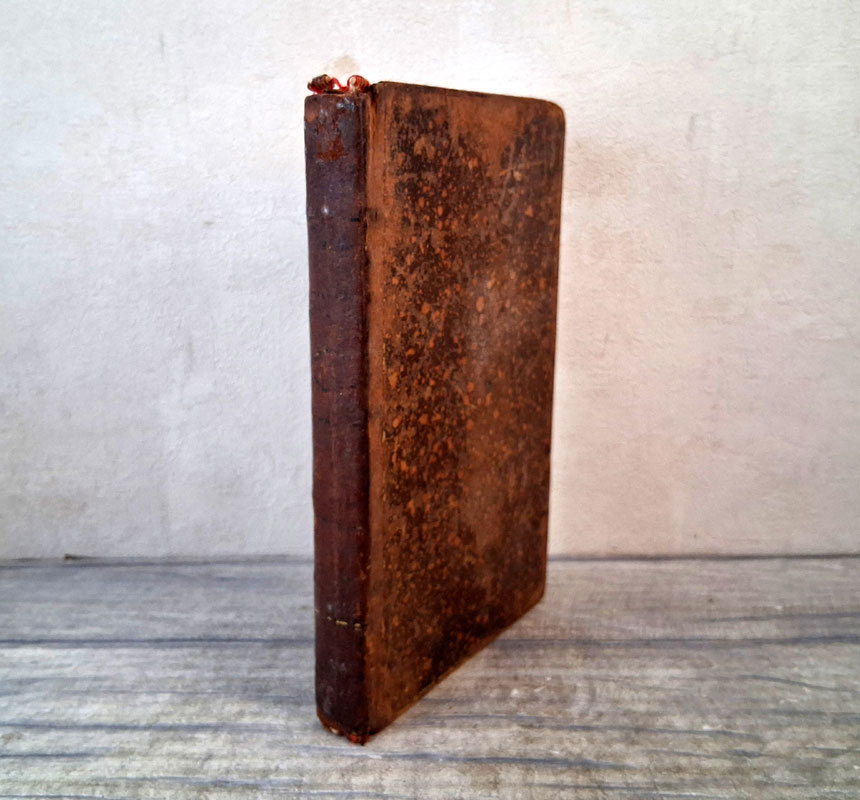
This is a 1787 edition of Jean de La Fontaine’s (1621–1695) “Fables Choisies, Mises en Vers par M. de la Fontaine” (Selected Fables, Set in Verse by Mr. de la Fontaine). Fontaine was one of the most widely read French poets of all time, best known for adapting ancient Aesop’s fables into sophisticated French verse. The Frontispiece depicts La Fontaine himself resting in nature, surrounded by the animals that feature in his fables (a stag, a lion, a boar). This was edited by M. Coste (Pierre Coste).

The timing of this book is interesting. The title page says ‘De l’Imprimerie de Fr. Amb. Didot l’Aîné’. The Didot family were the most prestigious printers in France, known for their technical perfection and the invention of the “Didot” typeface. This was printed just two years before the French Revolution. This has a simple cover and there are only feint marks left of the gold and black tooling on the spine. The leather is pitted and worn, and the red silk headband at the top and bottom are fraying. I like this as an well-used ‘honest’ binding, which looks like a book that was actually carried around and read, rather than just displayed.
That enjoyment is slightly muted when looking at the provenance. What makes this copy particularly interesting is the bookplate. Helpfully this is named ‘William Dickinson Esquire’.
The Shield features, on an Or (gold) field, an engrailed bend Gules (red) between two lions rampant, also Gules (red).
The Crest had a wreath supporting a cloud from which a cubit hand holding a rather thinly leafed twig (likely meant to be an olive or laurel branch) emerges. This does not appear in Fairbairn’s Book of Crests: the closest seems to be a ‘DickEnson’ where the hand is grasping a full laurel, rather than the fairly pathetic example seen here.
The arms seem to match with those recorded for William Dickinson (1745-1806) and his like-named son (1771–1837), which appear in S.W. Bates Harbin’s Members of Parliament for the County of Somerset, published by the Somerset Archaeological and Natural History Society in 1939 – pages 197 and 199. Both men were from Bristol and their family were slavers in Jamaica.
The elder was educated at the University of Edinburgh, and served as MP for Great Marlow, Rye (at the time this book was published) and then for the County of Somerset. He helped defeat Edmund Burke’s attempt at gradual abolition of the slave trade in 1780. He was probably no fan of Bridgwater’s petition against the trade in 1785.
The younger was educated at Christ Church in Oxford, where he matriculated in 1789 – the year of the French Revolution. He was MP for Ilchester and later for Lostwithiel. When slavery was abolished in 1834 he received a massive payout for the family estates in Jamaica.
Given the style of the bookplate, this book probably belonged to the younger of the two William Dickinsons. It is an interesting artifact of a book produced on the eve of the Revolution in France, and owned by someone in Somerset clearly cultured, but part of that same old world.