A major strand of my research is looking into intellectual culture in Scotland during the reign of James VI, and Marischal College in particularly. This centres around noble culture, but also the universities.
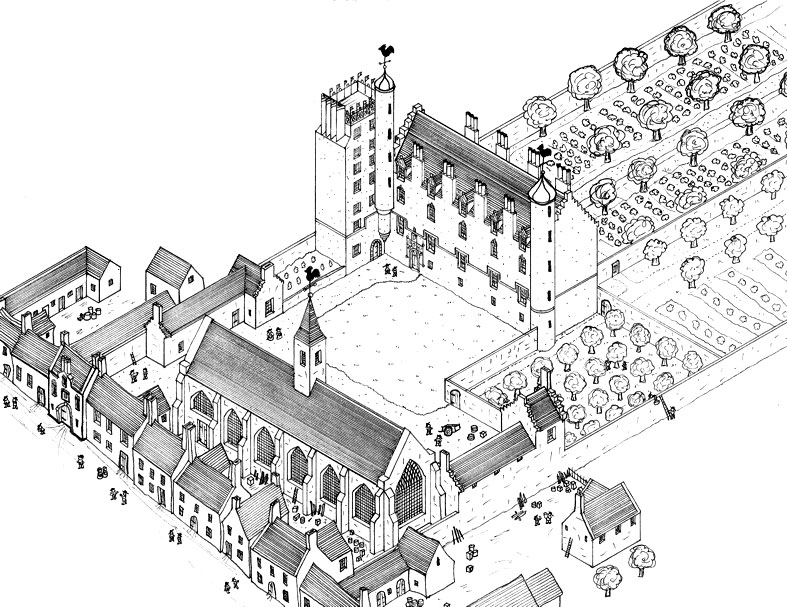
The Founding of Marischal College
I looked into the foundation of Marischal College in my book
- 2019 A Protestant Lord in James VI’s Scotland: George Keith, Fifth Earl Marischal (1554-1623), Boydell & Brewer.
The college was the result of a joint effort between the ministry in Aberdeen, the town council of New Aberdeen.
A key question is why on earth would this institution be founded when there was already a university up the road in Old Aberdeen? Older theories centred around the old institution being unreformed, either still being too Catholic, or unwilling to adopt a new foundation. I don’t think either of these were the case, at least not to the extent that the solution was a wholly new and separate university.
The First Book of Discipline had envisaged a new college within the university of Aberdeen, and this was probably the seed that became Marischal College, even if it didn’t come to pass. The ministers were keen to expand higher education and were happy with compromises to achieve this. The town council of Aberdeen wanted their own institution under their own jurisdiction. King’s College in Old Aberdeen was in a separate town, so may as well have been on the moon. The town council and the Earl Marischal were spurred into action by the creation of a short-lived university in Fraserburgh, by Alexander Fraser of Philorth. Neither town nor nobleman could countenance such an upstart town and minor laird having bested them in their sphere of influence.
The Earl Marischal had several motivations. He was a well-educated and cultured man who believed in the project. In his youth he had spent seven years travelling round European universities in France, Switzerland, Italy and Germany. The relationship with the ministers would improve his reputation with the Kirk, while that with the town council would help him get his new harbours at Peterhead and Stonehaven established (while Fraserburgh met staunch complaints from Aberdeen). But Marischal College would also scratch two important itches for the earl. One being simple human vanity: although the college was a joint effort, it would ultimately bear his name. And he would fiercely protect his rights as patron to the institution, even if he was conversely slow to help it financially.
His other main motivation was the in-built noble desire for eternity. Before the Reformation his predecessors could found monasteries or chapels and be remembered. Previous Earls Marischal had been buried in the Blackfriars of Aberdeen, and the 5th earl is said to have retrieved them and taken their remains to his new burial aisle of Dunnottar. But the burial aisle was not a public place of remembrance. Marischal College would be his secular memorial, essentially a noble monastery for a Protestant age.
Funeral Oratory in Marischal College
- 2016 ‘A Classical Send-off: the funeral oration of George Keith, 4th Earl Marischal (1623)’ in D. McOmish and S. J. Reid (eds) Neo-Latin Literature and Literary Culture in Early Modern Scotland, Brill Studies in Intellectual History, pp. 182-202.
This should read ‘5th Earl Marischal’, but was published before the proper numbering of the early earls became clear to me.
This article focused on the Latin funeral oration to the earl, composed by William Ogston, a professor in the college accompanied by extensive poems by the rest of the staff.
Lavish funerals were frowned upon by the Kirk, although nobles usually just ignored such censure. And as this service in Marischal College did not involve the dead earl’s body it seems to have passed without comment. Funeral oratory at Marischal College followed continental fashions, but doesn’t seem to have been taken up by the other Scottish universities.
Ogston’s oration is a cut-and-paste affair, with sentences and longer passages adapted from other works and orations. Lots are from classical authors, but a surprising number are taken from orations for Jacobus Arminius, the controversial Dutch theologian. Whether Ogston was making subtle allusions and theological statements for his audience, or whether his oration was a rushed composition founded on plagiarism is unclear. But it at least shows interesting themes in the relationship between the earl and the college, as well as the popularity of ancient Greek allusions.
Genealogy of the Keiths
The most interesting feature of Ogston’s oration is that it preserves for us a genealogy of the Keiths composed by the dead earl himself. Earlier genealogies of the Keiths cited the founder of the family as a killer of a Viking called Camus at the Battle of Barrie in 1010. The Earl Marischal pushes his family origins back many centuries and identifies them as the Chatti mentioned in the works of Tacitus. He then outlines their journey from Germany to Scotland. All of this is based on some very dodgy etymological work and wishful thinking. Although it is obviously bochum, this genealogy shows us the earl’s historical method (which many of his contemporaries were doing – Marischal was one of many who idolised the Chatti / Catti of Tacitus). Interestingly, like other nobles all over Europe, the earl was deeply engaged with the classical world and the history of the Romans. But being a Scot he was keen to identify with the enemies of Rome. Incidentally the earl acquired a Roman stone which he proudly displayed in the long gallery of Dunnottar.
It also shows us how the earl wanted his family’s history to be known. One interesting feature of the latter end of the genealogy is the notion that the earl’s grandfather, now known as ‘William of the Tower’, shut himself in Dunnottar during the reign of Queen Mary. He did not, but this neatly glosses over a controversial time when the Keiths sided with the King’s Party against the queen.
For the record, the earliest actual Keith known to history is Hervie de Keith in the reign of David I in the 1150s. Any earlier origins, either involving Camus or the Chatti, are very unlikely in the former case and definitely not the case in the latter. In this period it’s possible to trace almost all Keith lines in Scotland back to him and the main line of the Earls Marischal. Genealogical tables can be found as an appendix to the book A Protestant Lord in James VI’s Scotland.
Thomas Cargill and Justus Lipsius
An offshoot of the above work was finding that the Earl Marischal commissioned an Aberdonian school master, Thomas Cargill, to translate the ancient Greek poet Hesiod into Scots. Sadly that translation does not survive, but I did find a previously unknown translation work by Cargill, that of Justus Lipsius’ Six Books of Politics.
- 2027 with Roger Mason, Sixe Bookes of Politickes or civill doctrine by Justus Lipsius; faithfully and truly translated out of Latine in vulgare tongue by M. Thomas Cargill 1594, Scottish History Society (forthcoming).
I am currently working on a project with Roger Mason of St Andrews on the text of a 1594 political handbook. This books is by a man called Thomas Cargill schoolmaster of Aberdeen. He had previously been employed by the Earl Marischal to translate the Ancient Greek Hesiod into Scots. Sadly that text doesn’t survive, but while I was on the hunt for it I stumbled across this previously unknown manuscript by Cargill, which is a translation of the work by Justus Lipsius, Politicorum sive Civilis Doctrinae Libri Sex, the six books of politics and civil doctrine. To put it very simply, this was Europe’s big political hit in the generations after Machaevelli’s Prince, a key piece of intellectual history.
Lipsius was an intellectual giant of the late sixteenth century who is credited with reviving the classical philosophy of stoicism, which had a fundamental impact on politics and society across Europe. His Six Books of Politics is a practical guide to ruling a kingdom. In content it adds a powerful dose of Tacitean and Machiavellian realism to the advice it offers princes (ie it’s occasionally ok to do bad things for good results).
The form of this book makes it stand out: The Sixe Bookes is a scrapbook of classical quotes that weaves together a total of 2669 quotations from some 116 authors. As such, our Scottish Cargill translates a massive corpus of extracts from classical texts. The quality of his translation is top-notch, and ranks as well as any of the many other vernacular language translations that were produced at the same time across Europe. A major feature of importance in Cargill’s translation is his use of English rather than Scots. Cargill was certainly capable of writing in Scots but it seems he was aiming his translation at both English as well as a Scottish market, assuming his countrymen could read English but not the other way around. This unusually early example of Anglicisation has interesting implications for how we appreciate the understanding of the two languages in the 1590s, but also possible cultural anticipation for the potential Union of the Crowns.
Finally, at more of a tangent, I’ve written a history of the library of the University of Glasgow in the Reformation period.
- 2016 ‘From Foundation to 1700 – Renaissance and Reformation: Part 2’ in P. Davis (ed.) The University of Glasgow Library: Friendly Shelves, The Friends of the University of Glasgow Library, pp. 24-33.
This essentially sees the development of the library from just a collection of books into a proper institution. Like the other Scottish universities, an increasing culture of alumni bequests of books and money allowed for greater expansion of administrative capacity, allowing a proper dedicated space, librarian, down to the simple things like a library stamp.